UX engagement model
When I took over management of the design team, designers were burned out. Spread thin across every incoming stakeholder request, the team was producing high-touch but low-impact work. There was no process for prioritization, and no mechanism for translating research insights into design direction. Constantly shifting priorities caused in-progress work to be abandoned multiple times per quarter. This was an urgent morale issue.
I began by listening: conducting 1:1s with both leadership and designers to understand their challenges. Concerns largely overlapped, but with a key tension: designers wanted more time to dive deep into the work while leadership wanted more design coverage and quicker turnaround. I drafted a process in the open, workshopping it with the design team and key stakeholders to build buy-in. From initial 1:1s to finalization, this took four weeks.
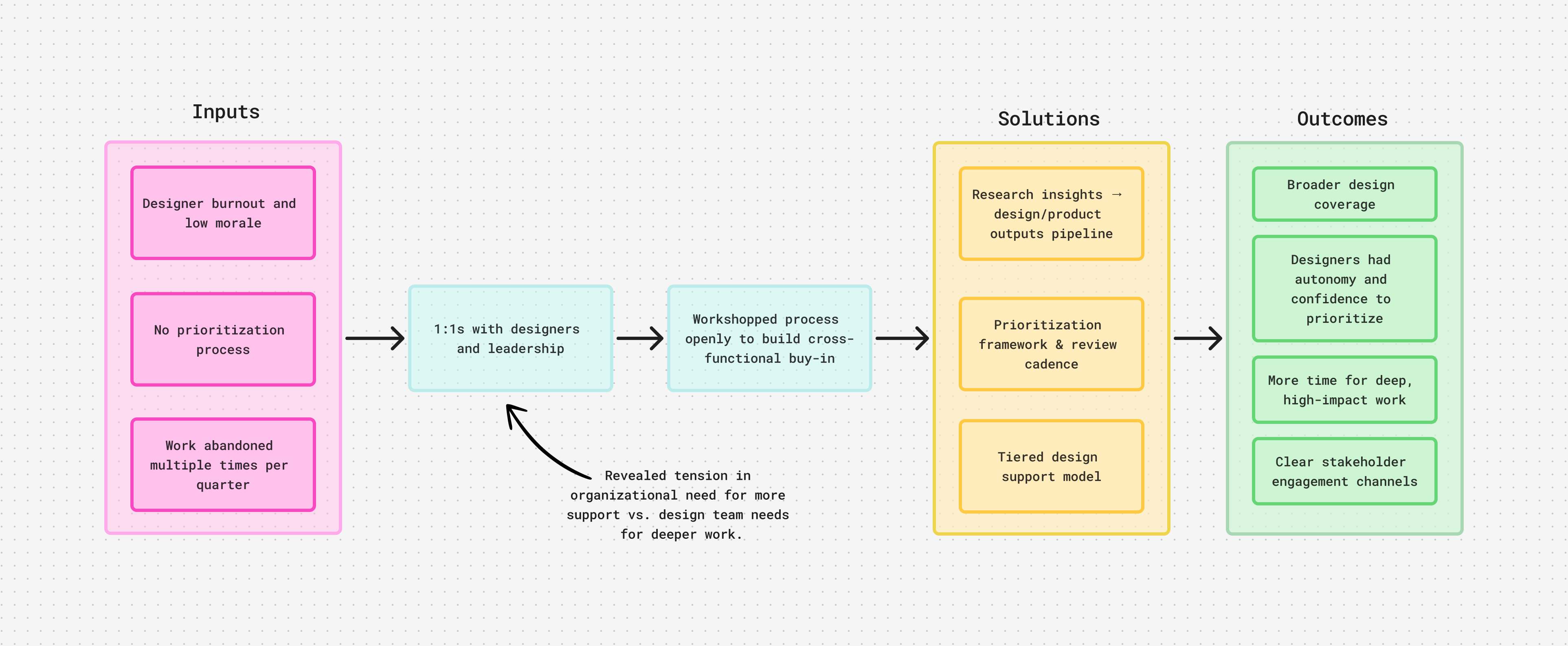
My final engagement model encompassed three components: a prioritization framework using reversibility, research validation, and customer trust impact as inputs fed into a scored rubric with a scheduled review cadence; a tiered support model categorizing work by level of engagement — dedicated design support for high-priority work and time-boxed mechanisms (office hours and consultancy) for the rest; and a research-to-design pipeline where findings fed into designer-led "how might we" workshops with product and engineering teams.
These mechanisms resolved the core tension: the team could support more projects overall while freeing up time for deeper work. The framework gave designers authority and confidence to make prioritization decisions, and when difficult stakeholders pushed back, I stepped in to reinforce those decisions. Because I had gotten stakeholder agreement from the start, those conversations were straightforward. Designers felt less stressed, had clear mechanisms for engaging with stakeholders, and knew I had their backs.
© Emilie Thaler 2026. Portfolio made with ♥, Kirby CMS, & Claude Code.